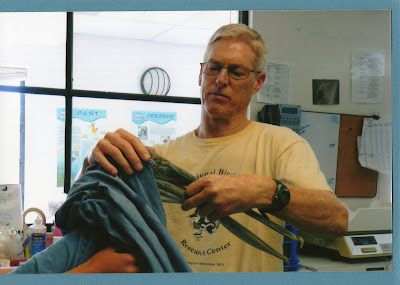
Here I am, a few weeks ago, checking for signs of dehydration on this pelican. This picture was on a card given to me by the staff of IBRRC. They are such good people. Anyhoo, I like it because it gives the impression that I know what I'm doing.
Last Saturday, after I did the outside feeding with Deborah, I worked with Monte doing exams, etc, on the outside pelicans, loon, and cormorants. Working with Monte is such a learning experience.

Early in the morning inside the pelican aviary, I'm getting ready to hose things down, remove old fish, and put in clean fish tubs with mackeral and day smelt.

The cormorants and pelicans are keeping their eyes on me. If I was holding a net, they would be moving away quickly.


We keep track of which birds are perching on the high perch - one of the requirements for release.

What beauty this is!

Two black-crowned night herons, a juvenile in back, and an adult in front. This is in one of the heron/egret aviaries.

I'm getting ready to give this pelican medicine. This pen is called a peli box, and is inside for birds who can't stay warm, are too sick, or can't get wet. I lovingly cleaned it out and made the bed an hour or so before this picture.

Getting the medicine down there! One has to make sure it is well past the trachea. Notice my typically wet feet - we are so cavalier at IBRRC! These pictures are taken on the fly as it is tough to take pictures while you are working because the birds come first. This is just a taste of one 10 hour day.

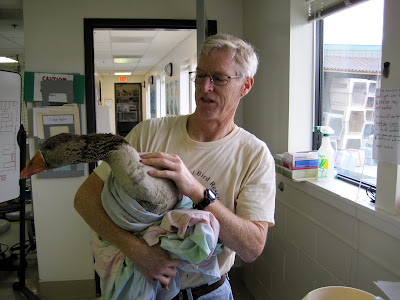 Here I am with "Grand Daddy", a Graylag goose that must have been someone's pet at one time.
 He holds his head close to you so you will scratch it. Grand Daddy is quite ill, however, and has difficulty standing and eating. He also is being treated for feather lice, and a possible fluke and tapeworm infection.
 Laura enjoying Grand Daddy's wonderful personality.
 This is a domestic duck - not a goose! He is the biggest duck you will ever see. He seems to be recovering nicely and should be placed soon. Domestic waterfowl cannot be released into the wild.
 Later in the afternoon, we took a young mallard duck for a short trip to be released into the nearby marsh. Most ducks seem to be leary of leaving the kennel, and after a few minutes, have to be gently dumped out. This duck was diagnosed to have been sick from an unknown toxic substance, but after a few days at IBRRC, is good to go.
 He lingered for a couple minutes to nibble on some weeds...
 and then rapidly took flight, zig-zagging down the stream. We were pleased with his healthy duck performance!